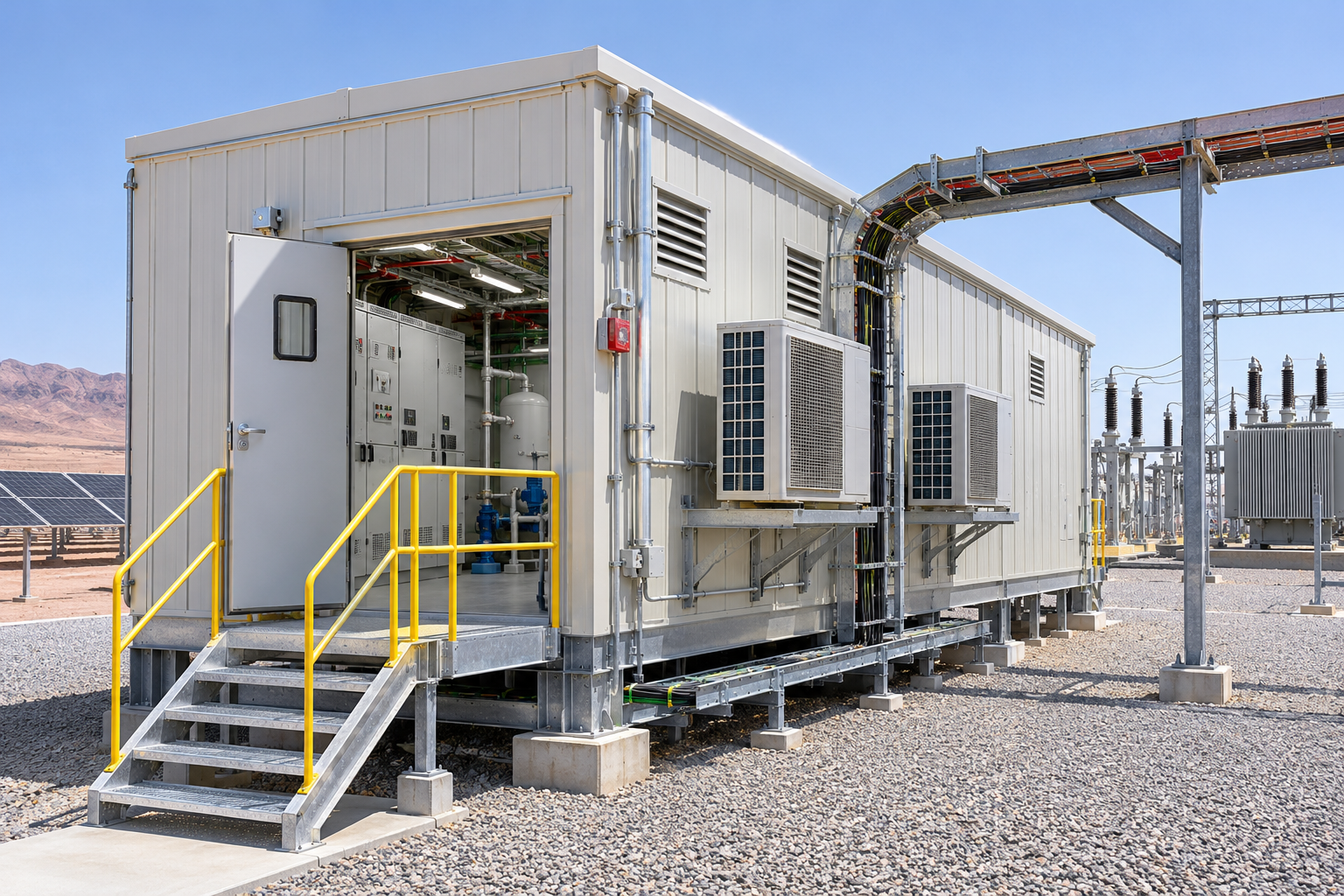
Remote mines, renewable plants, oil and gas facilities and infrastructure projects often face limited skilled labor, difficult weather and compressed construction schedules. A prefabricated E-House moves much of the equipment installation, wiring and functional testing into a controlled factory environment.
The module may contain medium- and low-voltage switchgear, protection panels, control systems, UPS and DC supplies, communications, HVAC and auxiliary services. Its value comes from complete integration rather than from the enclosure alone.
Design the Module for Its Destination
Ambient temperature, solar load, dust, humidity, corrosion, altitude and seismic duty affect insulation, cooling and structural design. HVAC capacity should include equipment losses, occupancy, solar gain, filter loading and degraded operating modes.
Transport can impose stricter limits than operation. Module dimensions, mass, lifting points, split lines and internal bracing must suit the road, rail or marine route and the cranes available at site.
Interfaces That Need Early Agreement
Incoming and outgoing power cables, bus ducts and transformer connections.
External grounding, lightning protection and bonding of removable sections.
Control, fiber-optic, fire-alarm and plant-communication interfaces.
Auxiliary power, backup power, HVAC, lighting and emergency systems.
Foundation, access stairs, platforms, doors, escape paths and maintenance clearances.
Site assembly sequence, weather sealing and re-test requirements after transport.
Factory Integration Changes the Test Strategy
A full factory-acceptance test can verify protection logic, interlocks, SCADA points, alarms, HVAC controls, UPS autonomy and sequence-of-operation before the module leaves the factory. Customers should define the test scripts and witness requirements early.
After delivery, site testing confirms transport integrity, cable connections, grounding and interfaces to field equipment. Clear boundaries between factory and site responsibilities reduce duplicated work and commissioning gaps.
Next Step
For integrated medium- and low-voltage distribution, review SOVIN’s secondary unit substation and discuss whether a compact outdoor package or a larger E-House arrangement better fits the project.
Technical reference: project-specific IEC, IEEE/ANSI, structural, fire-safety and environmental requirements.
Utility-scale battery storage is expanding rapidly. The U.S. Energy Information Administration reported in August 2026 that operational battery storage capacity reached nearly 52 GW in the first half of the year after averaging 70% annual growth o...
В 2026–2027 годах мировой спрос на электроэнергию будет расти ускоренными темпами. Узнайте, почему эффективность трансформаторов, пропускная способность энергосистемы, заблаговременное определение технических характеристик и скоординированное планирование распределительного оборудования имеют важное значение для новых энергетических проектов.
Fast-charging networks are increasing both the number and the power rating of public charging points. The International Energy Agency’s Global EV Outlook 2026 reports that fast and ultra-fast chargers grew from 1.5 million in 2024 to 2.2 million i...
Как одно из распространенных устройств управления распределением электроэнергии, автоматический выключатель незаменим практически во всех сферах потребления электроэнергии. По мере дальнейшей модернизации городов автоматические выключатели постоянно совершенствуются. С развитием Интернета вещей...
 Популярные категории












Отправить запрос о продукте
Мы свяжемся с вами в течение 24 часов